 Via Einstein, 23 Avigliana (TO)





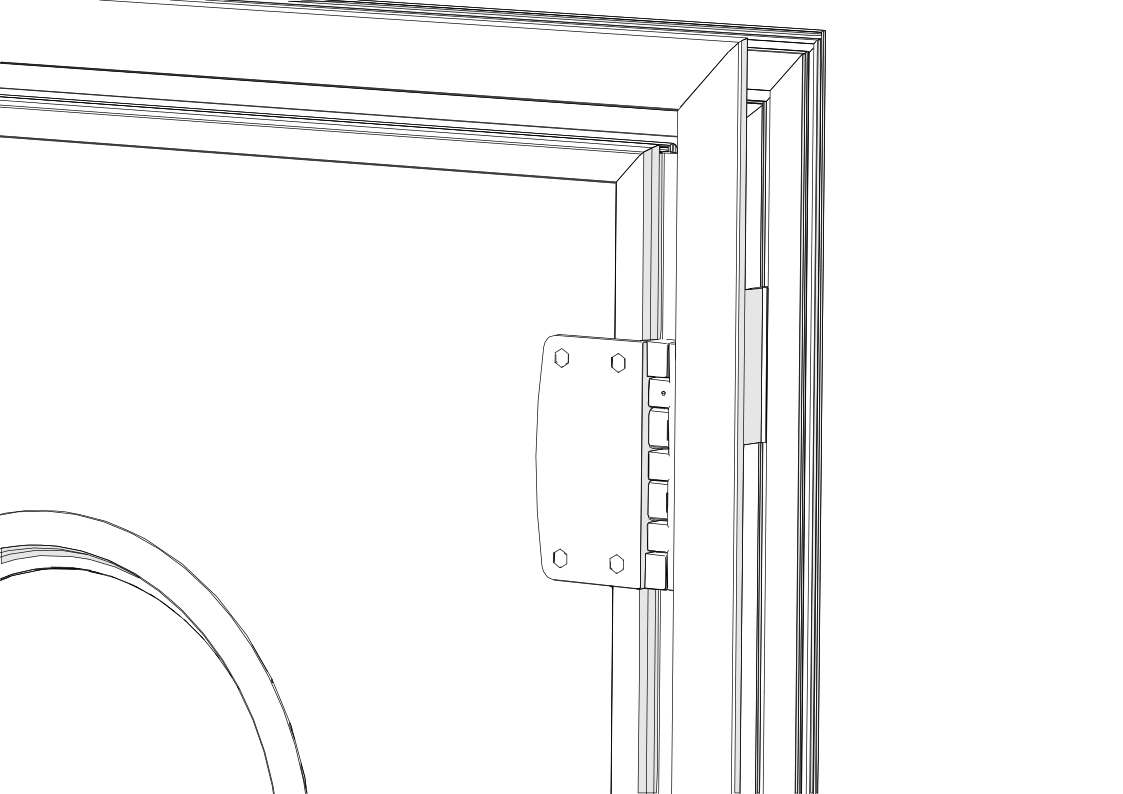
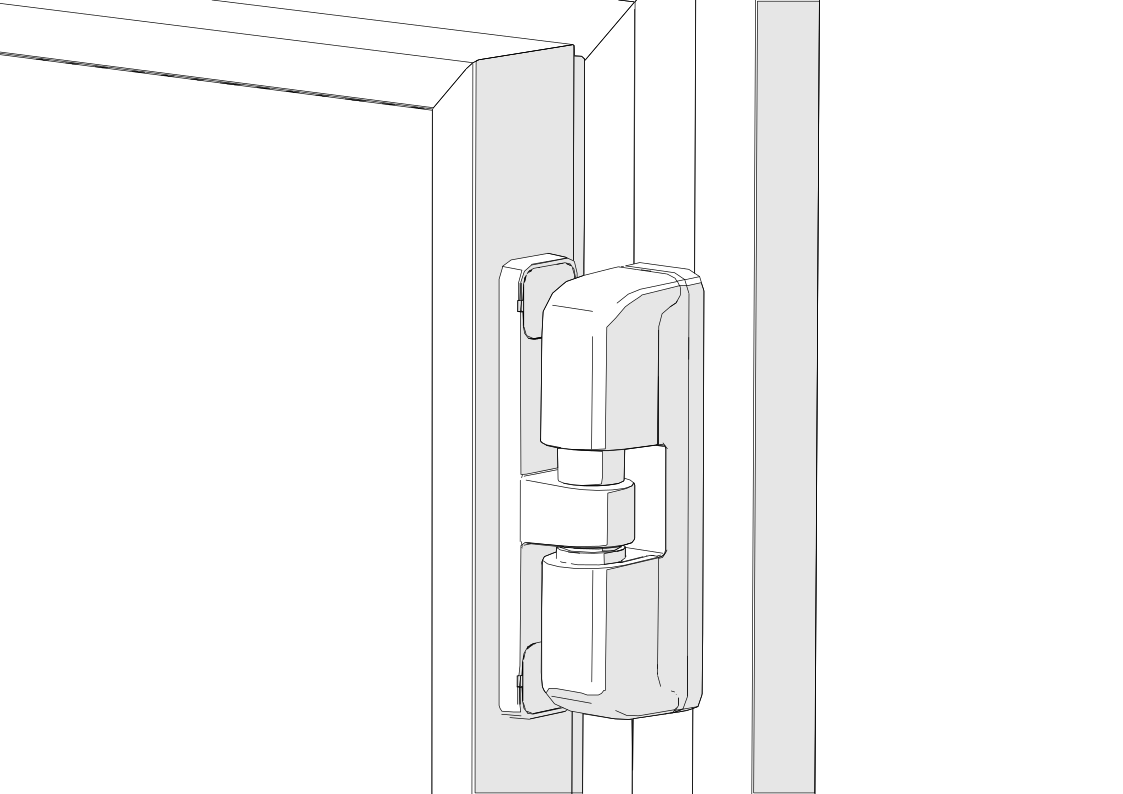
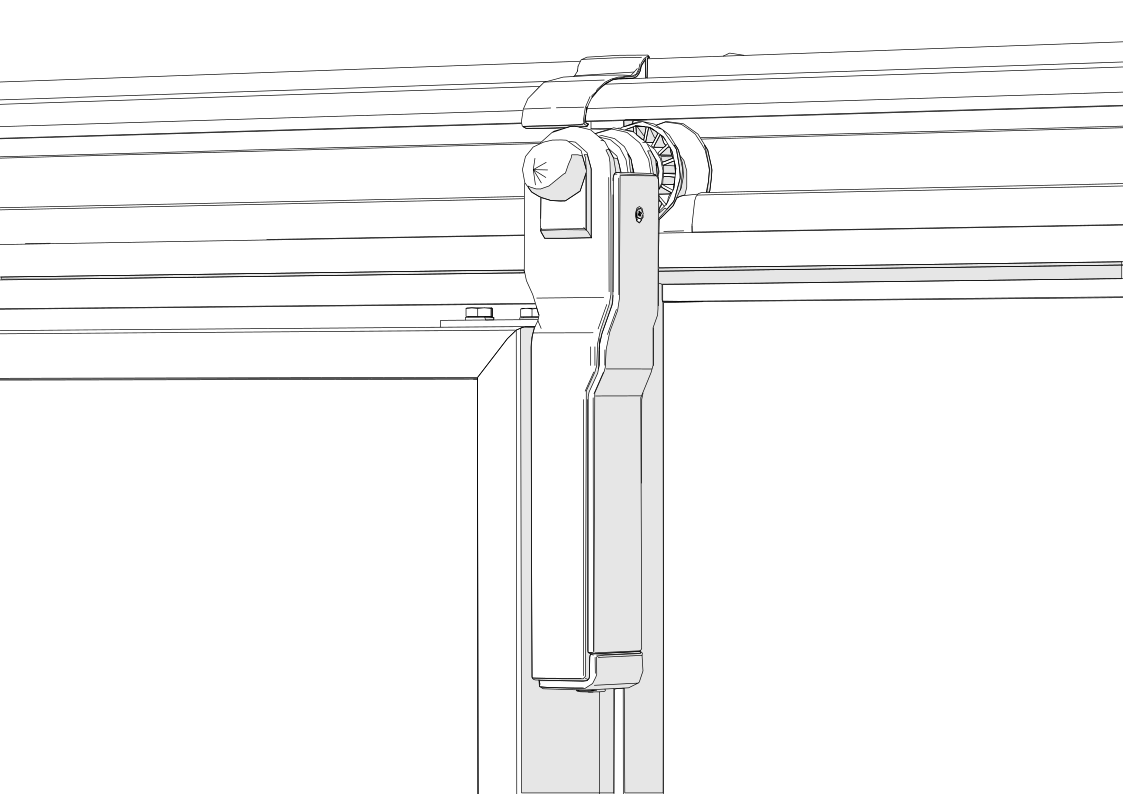

In refrigerated warehouses, the energy bill isn't decided by the refrigeration unit alone: it's decided at the openings. Every poorly insulated door is a leak through which cold escapes and heat, humidity and cost come in. That's why sliding or high-speed cold room doors, designed as true thermal barriers, are one of the most tangible savings levers for food and logistics companies.
The invisible gap: where your warehouse's energy really goes
When analysing the energy consumption of a refrigerated warehouse, attention almost always focuses on compressors, condensers and system control. That's only part of the picture. The refrigeration system is not the cause of consumption: it is the response to a thermal load. If the load increases, the compressor works harder, cycles get longer, defrosts multiply and the bill goes up. And a surprisingly large share of that load enters through the most overlooked point of the building envelope: the doorway.
Today, the sandwich panels of a cold room have very low thermal transmittance and continuous surfaces. The doorway, by contrast, is a structural break in the envelope: it moves, it is crossed dozens or hundreds of times a day by forklifts and operators, and it must stay sealed while still being able to open. Three distinct phenomena coexist at that point. The first is transmission through the door panel, which depends on the thickness and quality of the insulation. The second is air infiltration with the door closed, linked to the tightness of the perimeter seals and the flatness of the door stop. The third, by far the most significant, is convective exchange during opening: the difference in density between the cold air inside and the warm air outside generates a two-way flow in which cold air escapes at the bottom and warm, humid air enters at the top.
This third phenomenon is the real heart of the problem, because it is proportional to the opening time and to the size of the doorway. A door that takes eight seconds to open and close, multiplied by two hundred cycles a day, keeps the warehouse "open" for almost half an hour every day. During that half hour, sensible heat comes in, but above all humidity comes in, and that is the most expensive hidden cost: water vapour condenses and freezes on the evaporator, reduces heat exchange, forces more frequent defrosting, and every defrost in turn releases heat into the cold room. It's a vicious circle you pay for twice.
This is why cold room doors should not be regarded as a building accessory but as a fully-fledged energy component, on a par with the evaporator or the control system. Two signs immediately tell you that a door isn't sealing: an abnormal frequency of defrost cycles, and frost or condensation concentrated near the doorway. When they appear, acting on the door means tackling the cause of consumption rather than its effect, with a targeted, quick intervention and a measurable return.
Industrial sliding doors: one single goal
Insulated cold room doors are a system, not just a panel. Their performance comes from the combination of three elements: the insulating core, the frame profiles and the perimeter seal. The insulating core is the heart of the door, and for low-temperature cold rooms its thickness increases significantly, because the temperature difference with the surrounding environment can exceed forty degrees. The profiles are the critical point: aluminium and steel conduct heat, and if they run through the panel without a break they become thermal bridges that cause condensation on the frame and ice on the threshold. This is where thermal breaks, PVC joints and anti-freeze perimeter heaters are needed. Finally, the multi-lip EPDM gasket must compress and recover over thousands of cycles: if it hardens, it leaves a gap of just a few millimetres which, over a ten-metre perimeter, is equivalent to a permanent hole in the wall.
For wide openings and heavy traffic, the sliding door is the natural choice: it moves along the wall without intruding on the handling aisle, and it transfers the panel's weight onto trolleys and track rather than onto hinges. It doesn't "sag" at the bottom corner and it doesn't lose the alignment of the door stop — the typical defect of large hinged doors after a few years of service. In addition, high-quality sliding systems use a cam movement in the final part of the stroke to press the panel against the frame, compressing the gasket evenly: that's the difference between a door that simply rests in place and a door that is truly sealed.
Food and logistics: protecting the product, not just the energy bill
For a food company, energy saving is never the only goal: it is the easiest benefit to measure of an investment that actually protects something far more valuable, namely the product. Infiltration doesn't raise the temperature of the cold room evenly: it creates stratification and localised warm spots, typically in the area in front of the doorway, where incoming or outgoing goods are located — in other words, the goods that are handled the most. Data loggers record a reassuring average while individual pallets undergo much wider temperature swings — and that's exactly what gets flagged in a HACCP audit or an IFS and BRC inspection. Add to this humidity: warm air condenses on cold surfaces, producing slippery floors in front of the door, frost on shelving and ice on the threshold. It is a safety issue even before it is a hygiene issue, and the most common cause of damage to perimeter panels. Finally, in temperature-controlled logistics, operational continuity matters: a door out of service at a loading bay blocks an entire flow, not just a doorway.
Before evaluating a quote for cold room doors, it's worth defining a few parameters, because they are what make seemingly similar offers truly comparable:
- Actual temperature difference, not nominal: a cold room at −25 °C in a warehouse that reaches 35 °C in summer works across a 60-degree delta.
- Daily cycles by time slot: they determine whether you need motorisation, a high-speed door or a double closure.
- Vehicles in transit and actual clearances: an undersized opening leads to systematic impacts and loss of alignment.
- Thermal bridges in the frame and anti-freeze solutions on the threshold and perimeter.
- Smooth, washable finishes compatible with sanitisation cycles.
- Safety and service: internal release always operational, safety edges, response times and spare parts.
How much you save depends on variables specific to each installation, and any percentage promised in advance should be treated with caution. What makes sense is to measure: the electricity consumption of the refrigeration unit over a representative period, the actual number and duration of openings, and the defrost frequency. Then compare the data after a few weeks of operation, under the same seasonal and load conditions. It is at this stage that doors stop being a cost item and become an asset with a calculable return, which continues as a structural saving throughout the component's service life. With an annual maintenance plan — inspection of the gaskets, cleaning and lubrication of trolleys and track, checks on heated thresholds and automation — that saving is fully preserved over time.
Cold room doors
Contact information for cold room doors.
For further information, write to us using our contact form.
WhatsApp contact: https://api.whatsapp.com/message/BWKLO7GYVGFDK1
Facebook page: https://www.facebook.com/mivrefrigeration
LinkedIn page: linkedin.com/company/mivinsulatingsystems